This is a proof of concept. Unfortunately, mobile devices don’t support the required technology for native head tracking in browsers. Therefore, ambisonics.market is desktop-first by design. If you would like to contribute to the development of a native iOS or Android app, please volunteer.

The spatial audio marketplace


When artists meet.


Where spaces and audiences interact.


Ambisonics empowers you, listener.
Cover
Cover: © Gabriel Wolf
Piano
Gabriel Wolf
Spatial Mix
Gabriel Wolf

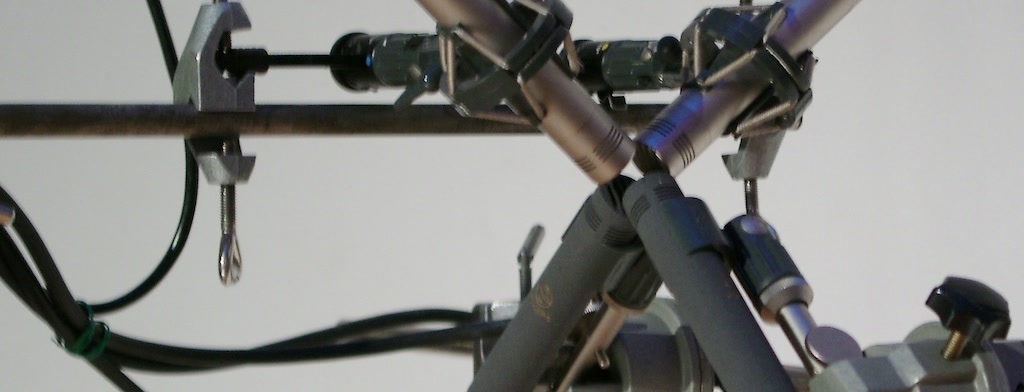
A demonstration of the 10 different encoding methods, called 'Designs' the Eigenmike software offers.

My aim for this short piece was, to show the inherent tradeoff between noise and spatial information. With each new step you get more spatiality, at the cost of noise.

This platform decodes up to third order Ambisonics, so what you hear is the first three orders of this test. In the original 6th order Ambisonics mix, the difference is more prominent.

Which 'Design' do you like most? Tip: use the numbers on your keypad to jump.

em64d Eigenmike A-Format to B-Format encoded 10 times
Recorded
Duration
2:00
Site
Living room
Gabriel Wolf
Sample Rate
48 kHz
Bit Depth
24-bit
Order
6
Cover
Cover: © Gabriel Wolf
Recording
Gabriel Wolf
Spatial Mix
Gabriel Wolf

Who was the nightingale singing to? The wind? The passing cars? The trees?

This is my very first em64d Eigenmike recording in the fields, powered by battery. I cycled around looking for one of the few remaining nightingales still singing, and I found this one. The bird was kind enough to just sit there in one place and sing for the recording. During post-production, I separated the bird's song from the rest of the audio signal, so that I could apply different equalisers and microphone array rendering types.

It's quite challenging to find the right amount of noise that is still acceptable, because some sounds and voices are noisy by nature. If you suppress the wrong frequencies, it sounds artificial right away. In my case, I wanted to record the nightingale. However, if I 'cut out' the bird and remove everything else, it doesn't sound right. Attempting to eliminate electrical noise by blindly attenuating high frequencies makes the recording sound cheap quickly, too. I am new to HOA recordings, but from what I have learned, a good step in the process of dealing with noise is, to start with (re)identifying all aspects, that were present in the scene.

The elephant in the room here was simply the sound of leaves whispering in the wind. I didn't notice it wile being enchanted by the bird.

Wind and cars vying for a nightingale
Recorded
Duration
10:00
Site
Public Park, Berlin, Plötzensee
Gabriel Wolf
Sample Rate
48 kHz
Bit Depth
24-bit
Order
6
Cover
Cover: © Image Shift
Production
Image Shift
Spatial Mix
Lasso Skinny
Anchored Transients - Symbiosis
Recorded
Duration
6:42
Site
Studio
Image Shift
Sample Rate
48 kHz
Bit Depth
24-bit
Order
3
Cover
Photo: © Gabriel Wolf
Recording
Gabriel Wolf
Spatial Mix
Gabriel Wolf
Nightingale ick hör dir trapsen
Recorded
Duration
10:00
Site
Public park, Berlin
Gabriel Wolf
Sample Rate
48 kHz
Bit Depth
24-bit
Order
3
Cover
Photo: © Gabriel Wolf
Recording
Gabriel Wolf
Spatial Mix
Gabriel Wolf
An early bird, singing
Recorded
Duration
9:08
Site
Balcony, Berlin
Gabriel Wolf
Sample Rate
48 kHz
Bit Depth
24-bit
Order
3
Cover
Cover: © Gabriel Wolf
Voice
Gabriel Wolf
Spatial Mix
Gabriel Wolf

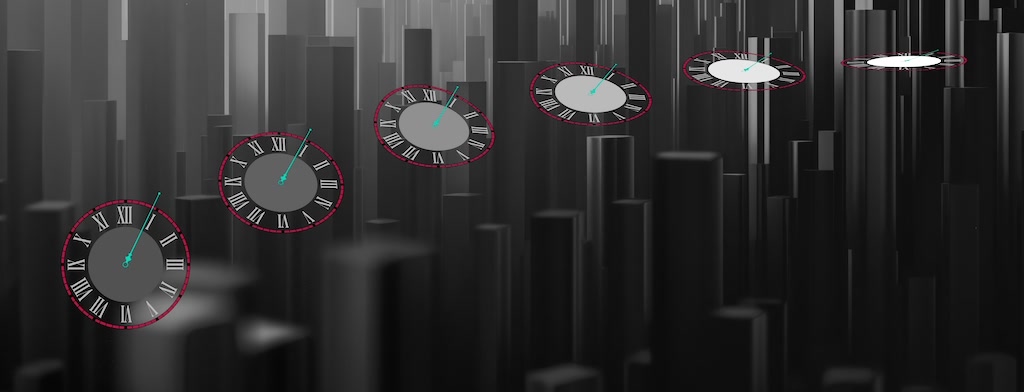
Imagine a clock tilted by +90°.

The recording was made with a Schoeps MK2H. The signal was rotated in third order Ambisonics with the IEM MultiEncoder plugin. Impulse response reverb was added with Ambi Verb HD (Jeanne d'arc Church). Reaper was used for processing and rendering.

Clock
Recorded
Duration
0:18
Site
Home
Gabriel Wolf
Sample Rate
96 kHz
Bit Depth
24-bit
Order
3
Cover
Photo: © Robert Faessler
Organ
Daniela Niedhammer
Composer
César Franck: Prélude op. 18
Recording Engineer
Gabriel Brachtel

Thanks to talent and kindness of Ms. Daniela Niedhammer, I was able to realise one of my first Ambisonics recordings.

In order to get my A-levels I had to write a skilled work. Supported by Hermann Voßeler, Ingo Kube, Albert Frasch and my father Walter Brachtel (†), I could set up a first order Ambisonics microphone using four Schoeps MK4 cardioid condenser microphones, arranged in a similar way (tetrahedron) as disclosed in the patent of Michael Gerzon. In comparison with higher order microphones, localization is blurry.

What holds up is a distinct quality of reverb and a wonderful interpretation of Ms. Niedhammer.

César Franck: Prélude op. 18
Recorded
Duration
3:05
Site
Church, St. Quirin, Munich-Aubing
Daniela Niedhammer
Sample Rate
44.1 kHz
Bit Depth
24-bit
Order
1
Cover
Still: © Jens M. Meyer & Steven Backer
Guitar
Matt Larocca
Composer
Duane Allman
Recording Engineer
Dr.-Ing. Jens M. Meyer
Recording Engineer
Steven Backer

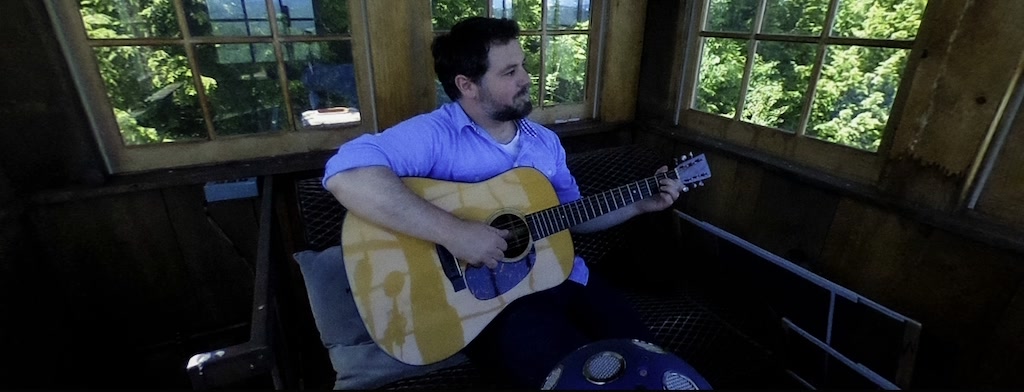
This recording was made using an em32 Eigenmike by mhacoustics.

The Barn - Little Martha
Recorded
Duration
2:34
Site
In the forrests
Matt Larocca
Sample Rate
44.1 kHz
Bit Depth
24-bit
Order
3
Cover
Photo: © Anna Deischl
Conductor
Manuel Hartinger
Choir
Junger Münchner Kammerchor
Composer
Ēriks Ešenvalds
Recording Engineer
Gabriel Wolf
Spatial Mix
Gabriel Wolf

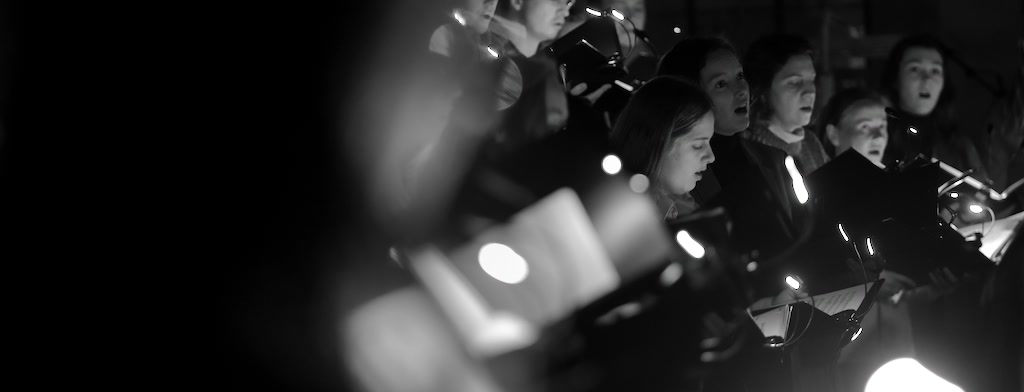
Imagine standing among some of the kindest and most talented aspiring singers of your hometown – who helped with the equipment, and knew by heart how to hold you after the concert – as the voice of a cello emerges from behind you on the left and enters into conversation with a viola voice so salving that my late mother’s long service of care and sacrifice could finally be filed under unsuccessful practice.

The concert recording has been on my hard drive for over two years now. I tried to finish the spatial mix countless times, and, admittedly, that was a challenge. I had to overcome both technical and personal issues.

Deutsche Bahn made me two hours late, and we had less than thirty minutes left to set up eight microphones on three different systems. I wasn’t able to set levels with the choir prior to the concert. Consequently, when I corrected the Zylia ZM-1 midway through, crackling almost ruined the signal. I apologise for that.

On a personal level, every time I listened to this beautiful performance, I vividly remembered that special evening, and I found myself emotionally affected. I lacked the inner distance required to work professionally as an audio engineer. One needs to listen carefully for just a few parameters. They are more technical than we might think: easy to name, hard to identify. Balance. Tonality. Spatiality.

Only when I turned the room hard on the yaw axis all the way to the left, did the headlocked binaural downmix hold together; only then did the piece stop asking myself to be repaired. It started giving testimony: the cello left behind me, where my late father had always preferred the last row of the cello section, the viola at the centre where my mother’s practice had found its proper filing cabinet. The choir became what they were all that evening: not just singers, but attentive listeners.

Did I find a balance between the instruments and voices that would support the conductor’s interpretation? Above all, did I treat the composer’s intent with due respect?

Ēriks Ešenvalds - In Paradisium
Recorded
Duration
11:05
Site
Church, St. Benedikt, Munich
Junger Münchner Kammerchor
Sample Rate
48 kHz
Bit Depth
24-bit
Order
3
Cover
Still: © Gabriel Wolf
Piano
Jean-Pierre Collot
Cello I
Jakob Roters
Violin
Clemens Huber
Viola
Christopher Zack
Cello II
Johannes König
Composer
Benedikt Brachtel
Recording Engineer
Gabriel Wolf
Spatial Mix
Gabriel Wolf

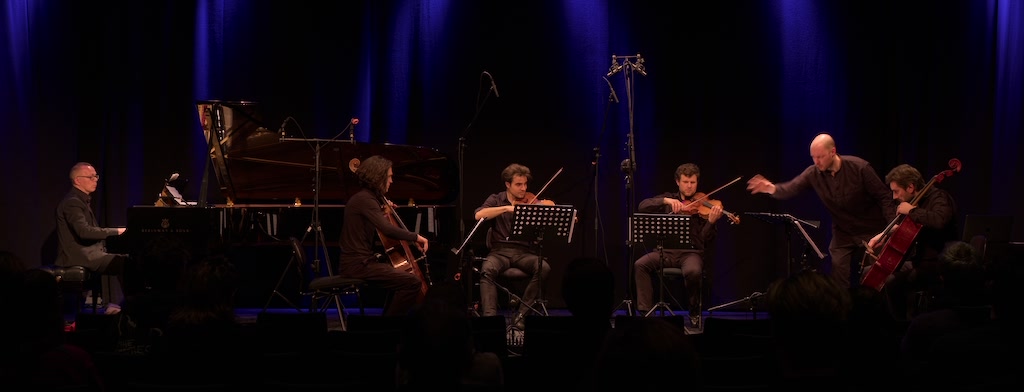
One cold, windy day in December, I travelled to my hometown to record my brother’s graduation concert. The audience was excited by the performance and so was I.

That evening I could test my new third-order Ambisonics microphone for the first time. I also made a binaural recording from my desk back in the far corner with the Sennheiser headset within my pinnae. This helped me as second reference during mixdown.

Everything went perfect. Before the concert I managed to crash my brother's laptop's Dante Audio, which he needed for live echo effects. Puh. Thanks to a local technician, we got the network fixed. The mix you are listening to is a combination of the Zylia ZM-1 and the Schoeps MK5 (set to cardioid) + MK2H on stage, with some additional higher order convolution reverb.

Graduation concert
Recorded
Duration
3:23
Site
Saal X, Gasteig HP8, Munich
Beni Brachtel
Sample Rate
48 kHz
Bit Depth
24-bit
Order
3
Cover
Photo: © Mike Senior / Gabriel Wolf
Piano
Andrey Yaroshinsky
Orchestra
Chamber Orchestra of The Gnessin Academy
Composer
Wolfgang Amadeus Mozart
Recording Engineer
Maria Soboleva
Spatial Mix
Gabriel Wolf

A spatially reimagined Mozart.

Thanks to Mike Senior, a driving force behind the Cambridge Music Technology Forum, one can experiment with an excellent performed and executed classical multitrack recording.

I used the IEM Plugin suite and a bit of Ambi Head HD reverb. Reaper was used as DAW.

You can find the multitrack files and details of the original recording here:

https://discussion.cambridge-mt.com/showthread.php?tid=20822

Wolfgang Amadeus Mozart - Piano Concerto No.12 K414 (Allegro)
Recorded
Duration
10:23
Site
Gnessin Academy Music Hall, Moscow
Andrey Yaroshinsky & The Gnessin Academy Chamber Orchestra
Sample Rate
48 kHz
Bit Depth
24-bit
Order
3
Cover
Cover: © Gabriel Brachtel
Composer
Gabriel Brachtel
Spatial Mix
Gabriel Brachtel

My first glimpse into Higher Order Ambisonics.

This Werck was made, when I built my first Ambisonics rig at home. A cube with eight no name active speakers, fed via a Behringer ADA-8000 ADDA converter and a PCI RME Interface. Good old days. :´-)

A VSpace experiment
Recorded
Duration
1:52
Site
Home
Gabriel Brachtel
Sample Rate
44.1 kHz
Bit Depth
24-bit
Order
2
Cover
Photo: © Gabriel Wolf
Recording Engineer
Gabriel Wolf
Spatial Mix
Gabriel Wolf

A signal-to-noise chitchat.

I had pulled an all-nighter coding this plattform; the sun was about to rise. From many failed attempts to get into the zone, I realised that you have to be ready at all times. My Zylia ZM-1 is always on a stand. I only had to grab the iPad, and take a few steps outside, to capture this excited roundtable discussion.

However, it took a few attempts to match the sound quality to my vivid memory of it. How much gain for each order? Am I allowed to EQ? What is the nature of the altered signal?

Early morning bird discussions
Recorded
Duration
9:58
Site
Backyard, Berlin
Gabriel Wolf
Sample Rate
48 kHz
Bit Depth
24-bit
Order
3
Cover
Still: © Gabriel Wolf
Piano
Gabriel Wolf
Recording Engineer
Gabriel Wolf
Spatial Mix
Gabriel Wolf

You may come across this improvisation one day, sir.

I would be delighted to listen if you would like me to say anything.

Piano improvisation for Attila
Recorded
Duration
4:06
Site
Living room
Gabriel Wolf
Sample Rate
48 kHz
Bit Depth
24-bit
Order
3
Cover
Still: © Gabriel Wolf
Piano
Gabriel Wolf
Composer
Alexander Nikolajewitsch Skrjabin
Recording Engineer
Gabriel Wolf
Spatial Mix
Gabriel Wolf

Memory or memorial?

When I was at school, there was an urgency around everyone. I don’t do esoterics or mysticism, but I remember something - something that kept me struggling on when luck wasn’t on my side. Unspoken words between like-minded humans.

A classmate - a double bass player - was preparing a little piano piece, and I fell in love with it dans un instant. I learnt it by heart swiftly and played it this way ever since. Please do yourself a favour, and don't look up the score to compare it note by note...

This remains one of the few recordings, where I can stand myself, Ferdinand. It shall be to you.

Alexander Skrjabin: Prelude in B-flat major, Op. 11, No. 21
Recorded
Duration
1:28
Site
Living room
Gabriel Wolf
Sample Rate
48 kHz
Bit Depth
24-bit
Order
3